
Garage floors
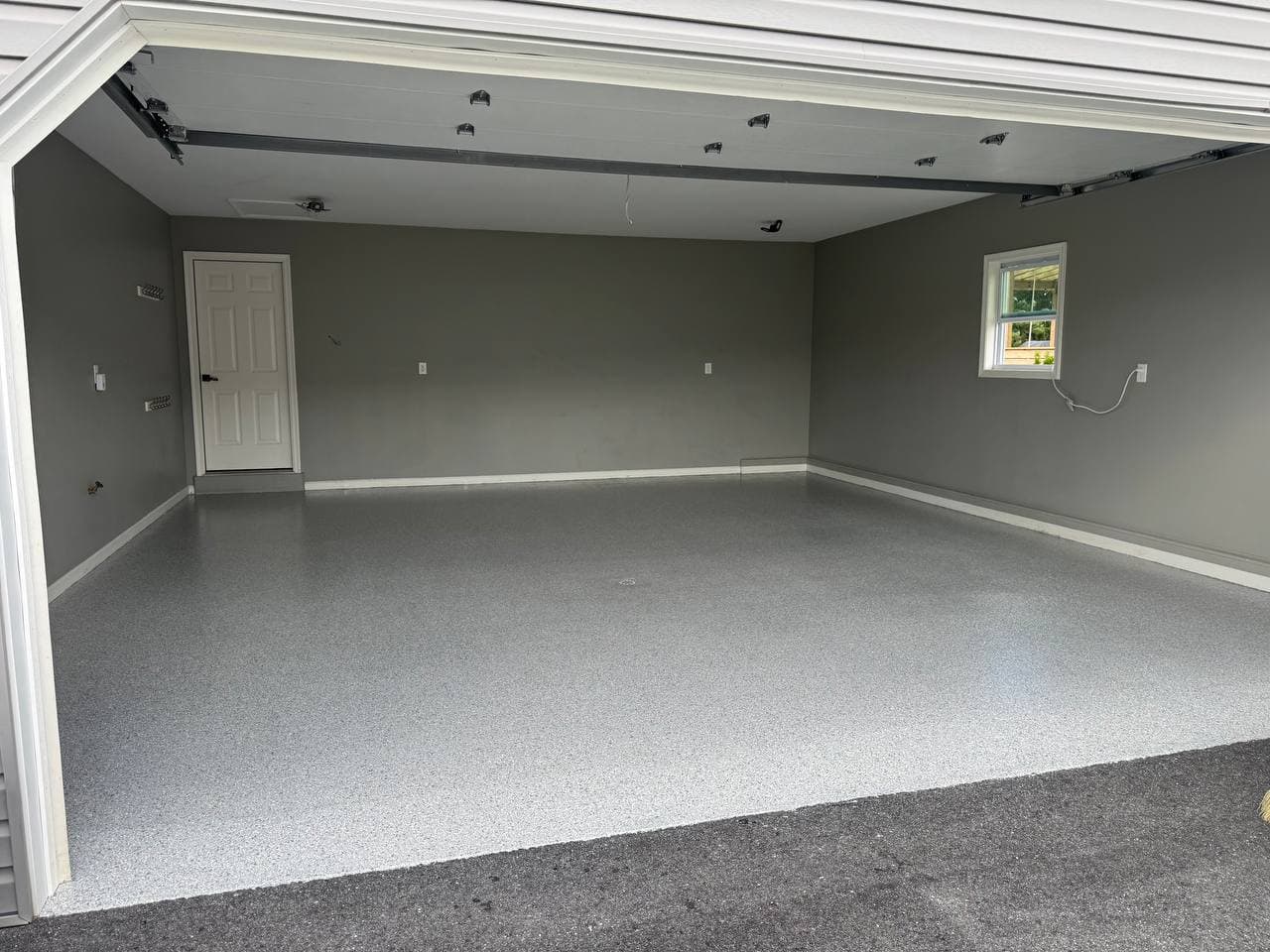
Garage floor coating in western Massachusetts
A garage slab in this valley takes more abuse than any other concrete on the property. Brine off the road all winter, hot tires all summer, and whatever gets dropped on it in between. We grind it back to bare concrete and rebuild it so none of that reaches the slab again.
What goes wrong with a bare garage slab
Concrete looks solid and behaves like a sponge. Salt water wicks in, freezes, expands, and pushes the top layer of the slab off in chips. Once that starts it does not stop on its own.
The other half of the damage is chemical. Oil, brake fluid and antifreeze soak into open concrete and stay there. No amount of degreaser pulls them back out.
- Pitting and spallingThe surface lifts off in flakes, usually starting where the car parks
- Permanent stainingAnything that leaks goes into the slab, not onto it
- DustingBare concrete sheds fine powder onto every tool and box stored on it
- Cracks that widenWater in a hairline crack becomes ice, and ice is a wedge
| System | Polyurea basecoat, flake broadcast, two polyaspartic topcoats |
|---|---|
| Total build | 30 to 40 mils over your slab |
| Prep | Diamond grind to CSP 2 to 3, no acid etch |
| Install time | One day for most two car garages |
| Back in service | Walk that evening, park in 24 to 48 hours |
| Warranty | 15 years, written |
| Price | $7 to $10 per square foot installed |
Why we do not use epoxy
Epoxy is brittle. It cures hard and stays hard, so when the slab moves with the temperature the coating has nowhere to go and it shears off. In an unheated garage in Massachusetts the slab moves constantly.
It also ambers. Any sunlight through the garage door turns a white or gray epoxy floor yellow within a couple of seasons. Polyaspartic is UV stable and does not do that.
The last problem is time. Epoxy needs days between coats. We are in and out in a day because polyurea and polyaspartic cure in about an hour each.
The prep is what you are paying for
Every quote in this trade includes a coating. The difference between a floor that lasts fifteen years and one that peels in two is entirely in what happens before the first coat.
We run metal bond diamonds over the whole slab until the concrete is open and the profile is right. It is slow, it is dusty, and it is the only way to get a mechanical bond. Acid etching and pressure washing leave the surface closed, which is why so many coated garage floors in this area are lifting at the edges.
Questions we get about this one.
How long will my garage be out of use?
One day for the install on most two car garages. You can walk on the floor that evening and park on it in 24 to 48 hours depending on the temperature.
Can you coat over an existing epoxy floor?
We grind it off. Coating over a failing coating just puts a new floor on top of a bad bond. If there is a lot to remove it adds to the price, and we tell you that on site before you commit.
Will it be slippery?
The flake itself gives the floor texture. If the garage gets wet often, or if it is a shop floor, we can add a texture additive to the final topcoat.
Do hot tires lift it?
No. Hot tire pickup is a failure mode of thin epoxy and of the kits sold in hardware stores. A polyurea and polyaspartic build is not affected by it.
Other floors we do
- BasementsMost basements in this part of the state sit on a slab poured decades ago, often without a vapor barrier under it.
- Patios and walkwaysExterior concrete has two jobs a garage floor does not: it has to survive full sun without changing color, and it has to stay grippy when it is wet.
- Pool decksA pool deck has to be safe with bare wet feet on it, comfortable in full sun, and able to shrug off chlorine and salt.
- Commercial and industrialOn a commercial floor the specification matters more than the color, and downtime usually matters most of all.
Send a photo of your floor.
You get a real number back, not a range and not a starting at.
$7 to $10 per square foot installed · 15 year written warranty