
Almost nobody in this trade will put a number on a web page. Call five contractors in western Massachusetts and four of them will tell you it depends, book an appointment, and give you the number in your kitchen an hour later.
It does depend. But it depends inside a range, and there is no good reason to keep the range secret.
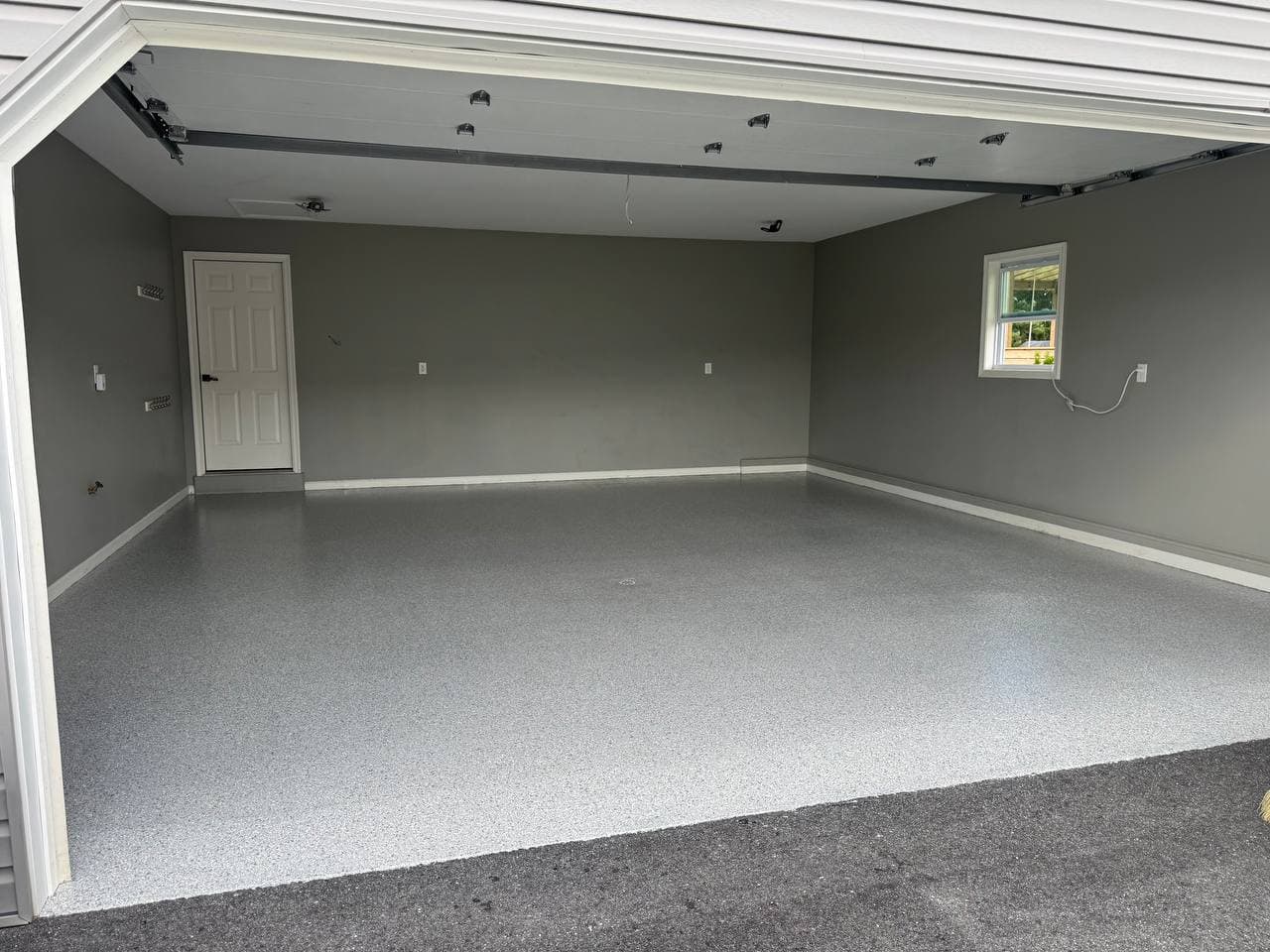
We install at $7 to $10 per square foot, materials and labor included. For a typical two car garage of around 440 square feet, that is roughly $3,080 to $4,400.
Why the range is that wide
The spread between the low end and the high end is almost entirely the condition of your slab. Two garages of identical size can sit at opposite ends of it.
At the low end: a slab in decent shape, no previous coating, minor cracking, easy access, straightforward layout.
At the high end: heavy spalling that needs filling and grinding flat, an old epoxy or floor paint that has to come off entirely, a moisture problem that needs a tolerant primer underneath, or a floor with a lot of edges, steps and obstructions that all have to be cut in by hand.
What is in the number
Every quote we write includes all of this. If you are comparing us against somebody cheaper, this is the list to compare against, because the difference is usually here rather than in the coating itself.
- Full diamond grinding of the entire slab, not just an edge pass
- Crack and spall repair, filled with polyurea and ground flat
- One full polyurea basecoat
- Vinyl flake broadcast to full refusal, then scraped and vacuumed
- Two polyaspartic topcoats
- Dust extraction throughout, and the debris leaves with us
- A 15 year written warranty
Where Massachusetts sits nationally
Labor rates in Massachusetts run meaningfully above the national average, and floor coating is labor heavy work. National cost guides put professional polyaspartic between roughly $5 and $12 a square foot across the whole country. In this state you should expect to be in the upper half of any national range you read, and any quote well below it is buying you less work rather than a better deal.
How to read a quote that looks too cheap
A $1,800 quote on a two car garage is not the same job priced lower. It is a different job. Usually one or more of these is missing.
No grinding. The single biggest cost in a floor is preparation. Acid etching or pressure washing instead of diamond grinding removes most of the labor from the job and most of the life from the floor.
Partial flake broadcast. Throwing flake at a set rate rather than to refusal can halve the material cost. It also looks like a speckled painted floor rather than a finished one, and it wears unevenly.
One topcoat instead of two. The second polyaspartic coat is where the wear resistance lives. It is also easy to leave out and impossible for you to see on day one.
Epoxy sold as polyaspartic. Ask what goes down first and what goes on top, by name. If the answer is vague, that is the answer.
What is genuinely optional
Some things really are extras rather than corners, and they should appear as line items rather than being hidden in the rate.
- Cove base where the floor meets the wall, common in basements
- Stair treads
- Anti slip additive, standard on our exterior work and available inside
- Moisture tolerant primer, only after a test says the slab needs it
Getting an accurate number
Rough dimensions and a few photos get you close over the phone. The fixed price comes from the site visit, where we measure, check moisture and look at what is actually going on with the concrete.
That visit is free, it takes about half an hour, and the number that comes out of it does not move afterwards. If we find something under an old coating that changes the scope, we stop and talk to you rather than adding it to the invoice.
What to do next
- Work out your own number on the pricing page, where you can put in your actual square footage and the shape your slab is in
- Read what the day looks like if you want to know where the labor actually goes
- See what we do to a garage floor specifically
Reference
Surface preparation standards referenced throughout our pricing come from the International Concrete Repair Institute, whose Guideline 310.2R defines the concrete surface profile scale (CSP 1 to 10) that coating manufacturers write their warranties against.