
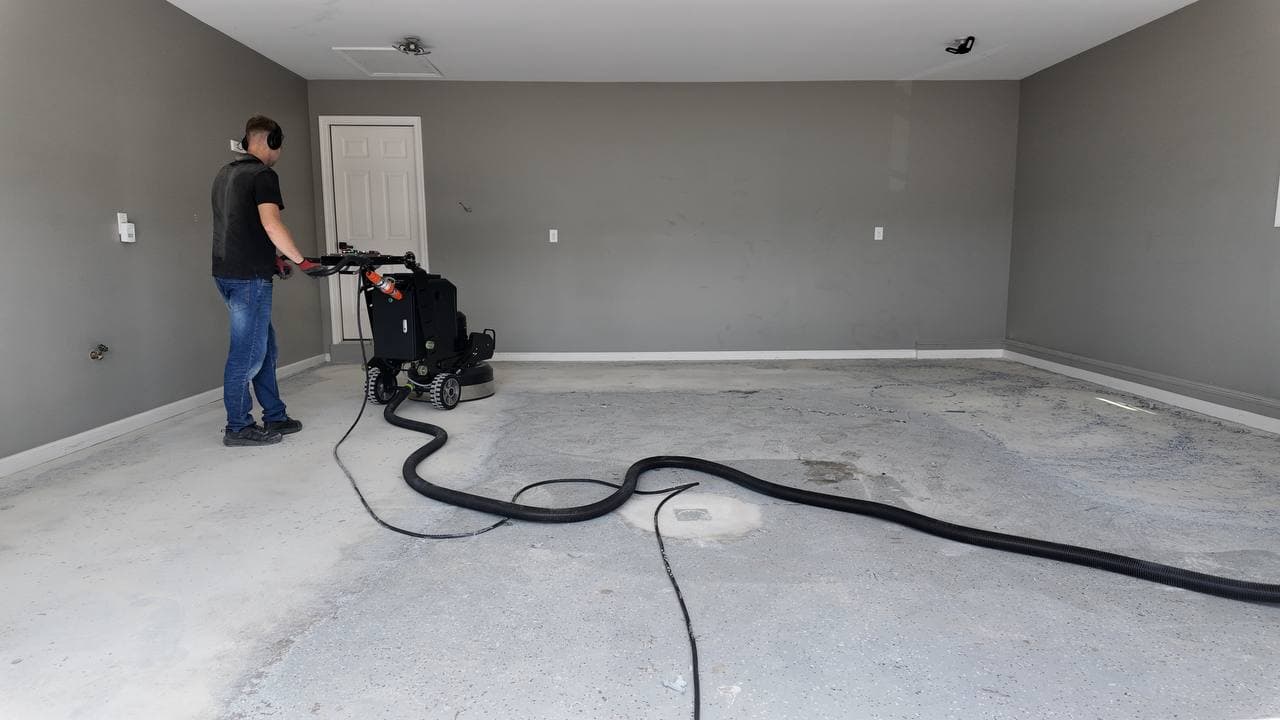
We get called out to look at failed floors regularly. In almost every case the product was fine and the preparation was not.
That is worth understanding before you hire anyone, because preparation is the part of the job you cannot inspect after the fact and the part that is easiest to skip.
The bond is mechanical, not adhesive
People picture a coating as glue that sticks to concrete. It is closer to a cast.
Concrete has a surface layer that is denser and smoother than the material below it, especially where it has been power troweled. That layer is closed. A coating applied to it sits on top, held by whatever surface adhesion it can manage, which is not much.
Grinding removes that layer and opens the pore structure underneath. The basecoat then flows into the open pores and cures inside them. The coating is not stuck to the floor, it is keyed into it. That is a mechanical bond and it is roughly an order of magnitude stronger.
The industry measures this as a Concrete Surface Profile, CSP 1 through 9. A flake system wants CSP 2 to 3. You get there with metal bond diamonds and nothing else.
The three shortcuts
Acid etching. Muriatic acid on the slab, rinsed off. It roughens the surface slightly and leaves residue behind that has to be neutralised completely or it interferes with the coating. It does not reach anywhere near CSP 2. It is fast, cheap, and it is the single most common cause of the floors we get called to look at.
Pressure washing. Cleans the floor. Does nothing to the profile. A clean closed surface is still a closed surface.
Grinding the middle only. Runs the machine over the open floor and hand grinds the edges badly or not at all. The floor fails at the perimeter first, which is exactly where you notice it.
The other failure modes
Preparation is most of it, but not all.
Moisture from underneath. Common in basements and in garages on slabs poured without a vapor barrier. Water vapor drives up through the concrete continuously and pushes a sealed coating off from below. This is why a basement should be moisture tested before it is quoted, not after it fails.
Coating over an old coating. Your new floor is only as attached as the old one was. Old epoxy or floor paint has to come off entirely.
Contamination left in place. Oil that soaked into the concrete years ago has to be pulled out or ground past. Coating over it gives you a floor that is bonded everywhere except the spots where the car used to leak.
Applying outside the window. Every product has a temperature and humidity range and a recoat window. Rushing or exceeding either produces a floor that looks correct on day one.
What to ask before you sign
Eight words: how do you prepare the slab, specifically?
Then listen for what is missing.
A good answer includes the word diamond, mentions grinding the whole floor including edges, and names a surface profile. It will probably also mention dust extraction, because grinding without it is unpleasant for everyone.
A bad answer is any of these: we acid etch, we pressure wash and let it dry, we scuff it up, or a general reassurance that they prepare it thoroughly without saying how.
Two answers should end the conversation: we do not need to grind, our product bonds to anything, and grinding is an extra. Grinding is not an upgrade. It is the job.
If your floor is already peeling
It can be fixed, but not by coating over it. Everything that has let go has to come off, and in practice that usually means the whole floor, because the areas still holding on are often only holding on for now.
That is more work than a bare slab, and it costs more. Which is the annoying arithmetic of a cheap quote: you pay less once, then you pay full price plus removal.
If you want to know which category yours is in, send us a photo. We will tell you honestly whether it needs to come off, and we will tell you if it does not.
Related
- Eight questions to ask any floor coating contractor
- How we prepare a slab, step by step
- Polyaspartic vs epoxy, which matters far less than this does
Reference
The concrete surface profile scale referenced here, CSP 1 through 10, is defined in Guideline 310.2R from the International Concrete Repair Institute. A flake system wants CSP 2 to 3, and that is achievable with diamond grinding rather than acid etching.