
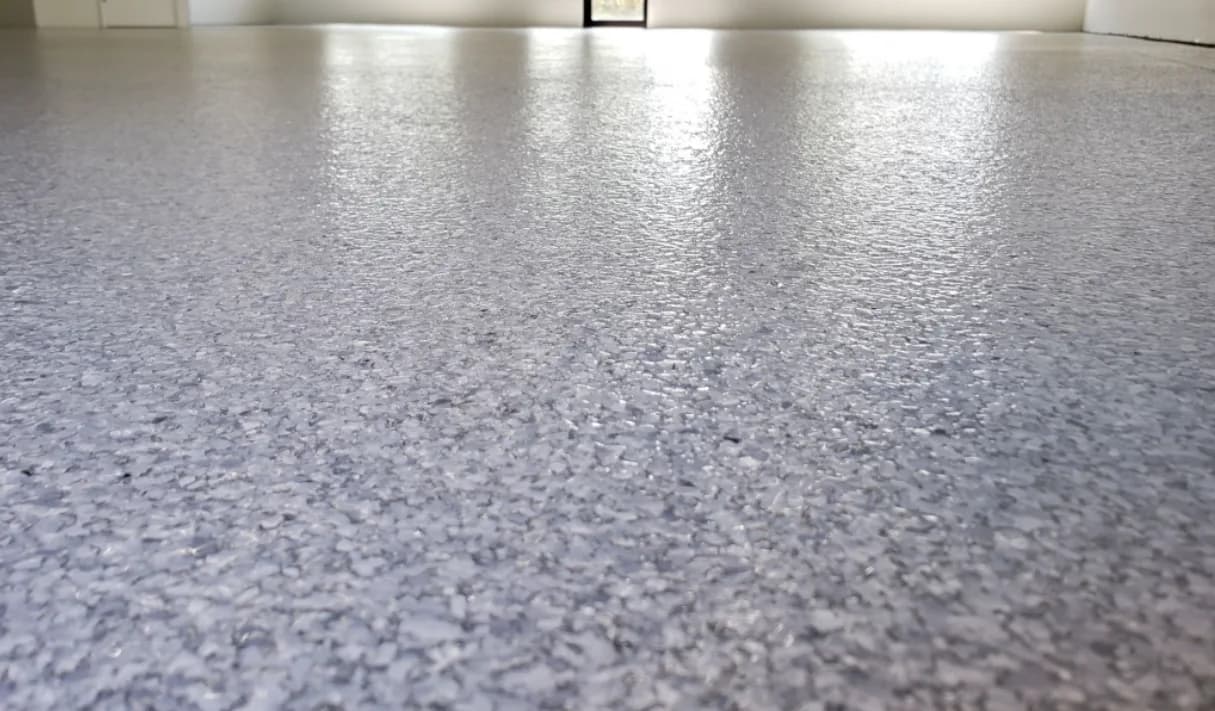
Both are resin floors. Both go down as a liquid and cure hard. That is where the similarity stops, and in a New England garage the differences decide whether the floor is still there in ten years.
The short version
| Epoxy | Polyaspartic | |
|---|---|---|
| Cure to recoat | 12 to 24 hours | About 1 hour |
| Full install | 2 to 4 days | 1 day |
| Install temperature | Roughly 55°F and up | Down to about −10°F |
| UV stability | Ambers in sunlight | Aliphatic, does not yellow |
| Flexibility after cure | Brittle | Stays flexible |
| Cost per gallon | Lower | Higher |
Flexibility is the one that matters here
A garage slab in Massachusetts is not a stable surface. It is an unheated concrete plate sitting on ground that freezes. It expands and contracts all year, and it does it hardest in the months when the temperature swings forty degrees in a day.
Epoxy cures hard and stays hard. Bonded to a moving slab it has two options: crack, or let go at the edges. Both look like peeling, and both show up two or three winters after installation rather than in the first season.
Polyurea, which is what our basecoat is, stays flexible after it cures. It moves with the slab instead of fighting it. Through roughly forty freeze and thaw cycles a year that is the whole difference.
UV, and why yellow floors happen
Epoxy is aromatic chemistry, and aromatic resins amber in ultraviolet light. Any sunlight through an open garage door will do it. A white or light gray epoxy floor turns a dirty yellow within a couple of seasons, worst in a band where the sun actually falls, which somehow looks worse than if it had yellowed evenly.
Polyaspartic is aliphatic. It does not do this. That is why it is the only sensible answer on a patio or a pool deck, and why we use it as the topcoat indoors as well.
Time, and what it costs you
Epoxy needs a day between coats. A full build is a three or four day job with your garage unusable throughout, and the cars living on the driveway in whatever the weather is doing.
Polyaspartic recoats in about an hour. That is why the whole floor goes down in one day, you walk on it that evening, and you park on it in 24 to 48 hours.
For a commercial floor that arithmetic gets much sharper. Three days of a warehouse aisle being out of service costs more than the difference in material price, usually by a lot.
Where epoxy is still the right answer
This is not a case where one product wins everywhere.
High build epoxy is genuinely useful where you need thickness: filling and levelling a rough industrial slab, building a slope to a drain, or laying down a deep body coat under a topcoat. It is also cheaper per gallon, and in a heated indoor space with no UV exposure and no rush to return it to service, that matters.
What it is not good at is exactly the set of conditions a Massachusetts garage provides: cold, sunlight through the door, a moving slab, and an owner who wants their car back tomorrow.
The honest downsides of polyaspartic
It costs more per gallon. On a residential quote that difference is real but modest next to the labor.
It is also unforgiving. A one hour cure means there is no time to fix a mistake mid pour, and the fast set demands a crew that has done it before. If it goes down over a slab that was not properly ground, it fails exactly as fast as epoxy would, because at that point the failure is the bond and not the resin.
Which is the real point. The argument between these two products matters far less than whether the slab under either of them was ground open first. A properly prepared epoxy floor beats a badly prepared polyaspartic one every time.
We use polyurea and polyaspartic because of the climate here. We grind every slab because that is what actually decides the outcome.
Where to go from here
- The system pages break down each layer, including what polyaspartic is bad at
- Why coatings peel covers the preparation argument in full
- Our pricing is published, so you can see what the material choice actually costs
Reference
The International Concrete Repair Institute publishes Guideline 310.2R, which sets out how concrete must be profiled before any of these coatings go down. It applies to epoxy and polyaspartic equally, which is rather the point.