
Every contractor who quotes your floor will tell you their system is the best one and their floor will not peel. The claims are identical, so they carry no information.
These eight questions do. They are all answerable on the phone in under a minute each, and the answers separate the quotes properly.
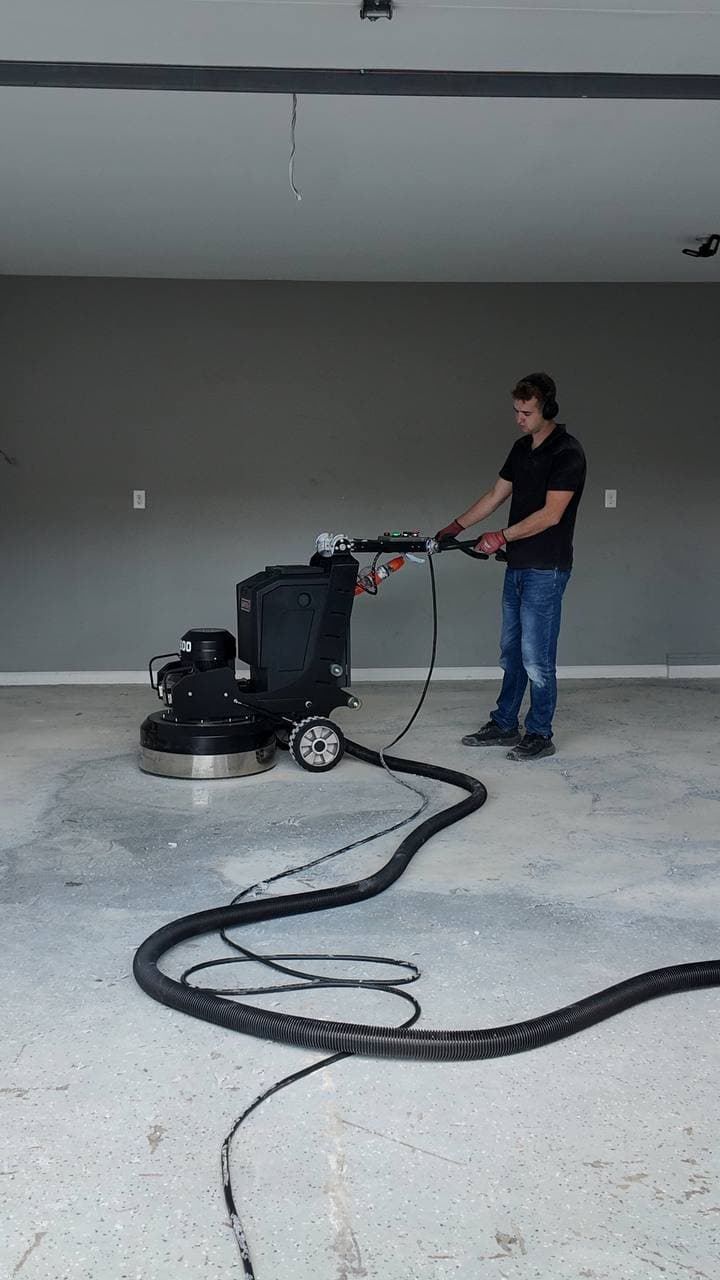
1. How do you prepare the slab, specifically?
The most important question by a distance.
You want to hear the word diamond, you want the whole floor including edges, and ideally a surface profile named, CSP 2 or 3.
Two answers should end the conversation: we acid etch, and grinding is an extra. Preparation is not an upgrade, it is the job, and it is the reason a floor is still bonded in ten years.
2. What exactly goes down, in order, by name?
A good answer is a list: basecoat product, flake, topcoat, number of coats each.
A vague answer, or a brand name used as if it explains the build, means either they do not know or they do not want you comparing. You are trying to find out whether the topcoat is polyaspartic and whether there are two of them, because the second one is easy to leave out and impossible to see.
3. Is the flake broadcast to refusal?
Full refusal means flake is thrown until the floor will not take any more. Partial broadcast scatters it at a rate and lets the basecoat show through.
Partial uses roughly half the material. It is a legitimate cheaper product, but it should be priced and described as one, not quietly substituted for the thing in the photographs.
4. What is the warranty, and is it written?
A verbal lifetime warranty is a sentence. Ask for it on paper, ask what it covers, and ask what voids it.
Ours is fifteen years, written, on residential floors. We chose a number we can actually stand behind for a company of our age rather than the word lifetime, which in this trade frequently means the lifetime of the business rather than the floor.
5. Are you licensed and insured, and can I see it?
In Massachusetts, home improvement contractors register with the state. Ask for the registration number and ask for a certificate of insurance.
This is not a formality. If somebody is injured in your garage or your house is damaged, the answer to this question is the difference between a claim and a lawsuit.
6. Who is actually doing the work?
Some of the larger operations in this region sell the job and subcontract the install. That is not automatically bad, but you should know it, because the person who gave you the warranty and the person grinding your slab may not work for the same company.
7. What happens if you find something under an old coating?
The right answer is that they stop and talk to you.
The wrong answer is silence, or a rate that quietly absorbs it. You want to know before work starts what happens when the scope changes, because on a floor with an existing coating on it, the scope sometimes changes.
8. What is the price per square foot, and what is in it?
If a contractor will not give you a range on the phone, you are booking an hour of your evening to find out something they could have told you in ten seconds.
Ours is $7 to $10 per square foot installed, and it is on the website. Where you land inside it is the condition of your slab and nothing else.
Two things that are not signals
A big showroom. Overhead is not craft, and you are paying for it either way.
A discount that expires tonight. Sixty percent off, this week only, act now. A real price does not need a countdown attached to it. If the number moves that far under pressure, the first number was not real.
What to do with the answers
Line the quotes up next to each other and compare question one and question three. That is where the money difference between a cheap quote and a fair one actually lives.
If you want a second opinion on somebody else's quote, send it to us. We will tell you honestly if it is a good deal, including when it is better than ours.
Related
- Why floors peel, which is question one in detail
- Full flake vs partial broadcast, which is question three
- Our published pricing and our terms, including what the warranty does not cover
Reference
When you ask about surface preparation, the answer you are listening for maps to Guideline 310.2R from the International Concrete Repair Institute, which defines the concrete surface profiles that coating manufacturers require for their warranties to stand.