
Most tired pool decks do not need to come out. Some genuinely do, and you can usually tell which is which in about five minutes with your hands and your eyes.
The question is whether the problem is at the surface or in the base.
Surface problems, which resurfacing fixes
Scaling. The top layer flaking away, worst near the coping and the steps. This is freeze thaw damage and it is cosmetic until it is deep.
Pitting. Small holes across the surface, often with a rough sandy feel between them.
Discolouration and staining. Sunscreen, leaf tannin, rust from furniture feet, chemical splash.
Hairline and crazing cracks. Fine cracks you cannot catch a fingernail in, or a shallow map of interconnected ones.
A dated finish. Exposed aggregate you have stopped liking, or an old paint that is peeling.
All of that gets ground, filled and coated, and it disappears.
Base problems, which it does not
A height difference across a crack. Run your hand across it. If one side sits higher than the other, the slab has moved, and a coating will follow the new shape rather than correct it.
Sections that rock or sound hollow. Tap around with a hammer handle. A drummy sound means a void underneath, usually washed out fill.
Water coming up through a crack. Hydrostatic pressure. That needs a drainage answer before it needs a surface.
Fall that runs toward the pool or ponds badly. A coating is millimetres thick. It cannot re-grade a deck.
Coping that has lifted or separated. Often a sign the deck has moved rather than a coping problem on its own.
The five minute test
Walk the deck barefoot. Feel for height changes at every crack and at every joint. Tap the hollow sounding spots. Look at where water sits after rain, and look hardest at the two feet nearest the pool, because that is where the deck fails first and where movement shows up first.
If everything is flat and nothing is drummy, you have a surface problem and resurfacing is the right answer.
What each costs, roughly
Resurfacing a sound deck is a coating job priced per square foot.
Replacement is demolition, disposal, forming, pouring and curing, plus the risk of damaging the pool shell and the coping during breakout. It is a multiple of the coating price, not a small premium, and it gives you a new slab that will start the same freeze thaw cycle from day one unless it is sealed.
That last point is worth sitting with. If you replace and do not protect the new deck, you have bought yourself another ten or fifteen years of the same process.
The honest middle case
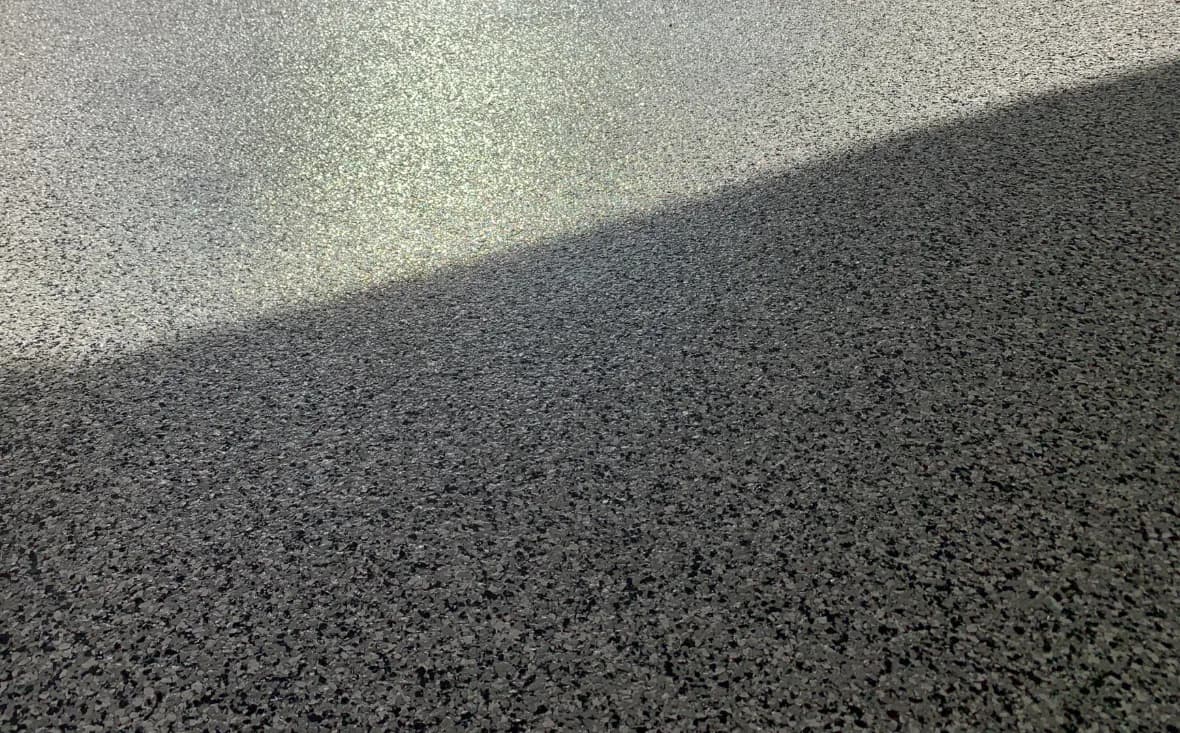
Sometimes a deck has one bad section and the rest is fine. Replacing a section and coating the whole thing so it reads as one surface is a legitimate approach, and the flake finish hides the join far better than bare concrete would.
Related
- What we do on pool decks
- Pool decks in a freezing climate
- What can still be coated, the same test applied to a garage
Reference
Substrate soundness is the first assessment before any resurfacing decision, as covered in the surface preparation guidance from the International Concrete Repair Institute.