
Most damaged garage slabs in this valley can still be coated. A few cannot. The difference is whether the damage is at the surface or through the slab, and you can usually work out which one you have in about five minutes.
Surface damage, which is fixable
Spalling. The top layer flaking away in patches, exposing the aggregate underneath. Usually worst where the car parks, because that is where the brine drips. Caused by freeze and thaw, and it is the most common thing we see.
Pitting. Small round holes across the surface, often with a rough sandy feel between them. Same mechanism, earlier stage.
Dusting. The slab constantly sheds fine grey powder onto everything. It means the surface is weak and friable, usually from a poor cure when it was poured.
Hairline cracking. Fine cracks you can see but not catch a fingernail in. Very common and almost always cosmetic.
Crazing. A map of shallow interconnected cracks, like a dried lake bed. Surface only, cosmetic.
Oil staining. Ugly, and it has to be dealt with before coating, but it is not damage to the structure.
All of that gets ground, filled and coated. It disappears completely under the finished floor.
Structural damage, which is not
Cracks with a height difference. If one side of a crack sits higher than the other, the slab has moved. Run a hand across it. If you can feel a step, that is settlement or heave, not a surface problem.
Cracks wider than about a quarter inch that run the length of the floor. Especially if they are still opening.
Sections that rock or sound hollow. Tap around with a hammer handle. A drummy sound means the concrete below has separated or there is a void under the slab.
Water coming up through a crack. That is hydrostatic pressure and it needs a drainage answer before it needs a floor.
A coating over any of these will look better on day one and the underlying movement will keep going. We would rather tell you that at the quote than warranty it.
What repair actually involves
For the fixable list, the sequence is the same on every job.
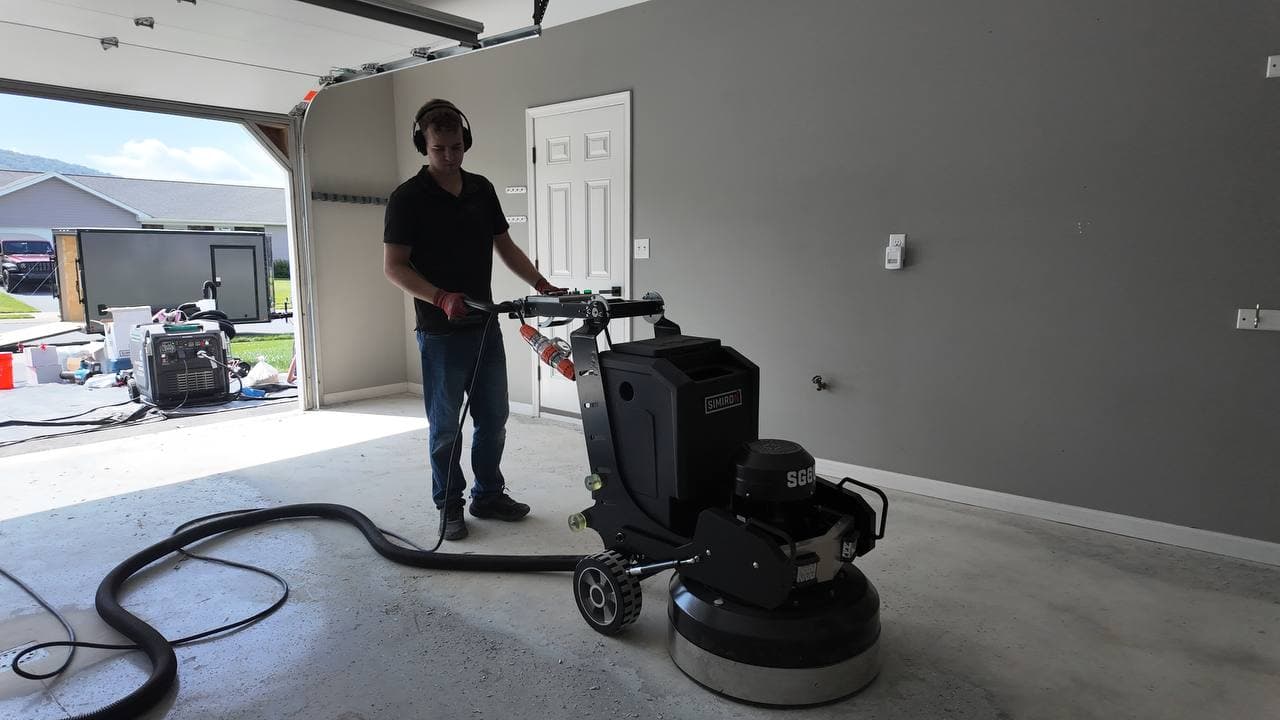
- Grind the whole slab first. You need clean, open concrete to bond a repair to, same as the coating.
- Chase out the cracks. Open them into a V with a crack chaser so the filler has something to key into. Filling a hairline crack without opening it just paints over it.
- Fill with polyurea. It cures in minutes and stays slightly flexible, so it moves with the slab instead of popping out.
- Grind the repairs flat. This is where a rushed job shows. A proud repair reads as a ridge through the finished floor forever.
- Fill the pits. Spalled areas get filled and levelled the same way.
- Then the floor goes down.
Control joints, the deliberate saw cuts in the slab, are a judgment call. They are there to let the slab crack in a straight line. Filling them rigidly can force the crack somewhere else. We usually fill them flexibly and carry the coating across, and we will explain what we are doing on your particular floor.
Does the repair show?
Under a full refusal flake floor, no. That is one of the practical arguments for flake over a solid colour: the visual noise hides everything underneath it, including repairs.
Under a metallic or a solid colour floor, a large repair can telegraph. It is one of several reasons we steer people away from those finishes in a working garage.
What it costs
Repair work is the main reason a garage lands at the top of our $7 to $10 per square foot range rather than the bottom. Heavy spalling across most of a floor can add hours before anything can be coated.
Which is the case for not waiting. A slab at the fine dusting stage is at the cheap end. The same slab five winters later is at the expensive end, and the coating is identical.
Not sure which you have
Send photos. Include one wide shot of the whole floor and close ups of anything that worries you, and put a coin or a tape measure next to any crack so we can judge the width.
We will tell you honestly whether it is coatable, and if it is not we will tell you that too rather than taking the job.
Related
- What road salt does to a slab, which causes most of what is on this list
- How repairs fit into the day
- Send photos and get a number
Reference
Whether a damaged slab is a candidate for coating comes down to substrate soundness, which the International Concrete Repair Institute addresses in its surface preparation guidelines alongside the profile requirements.