
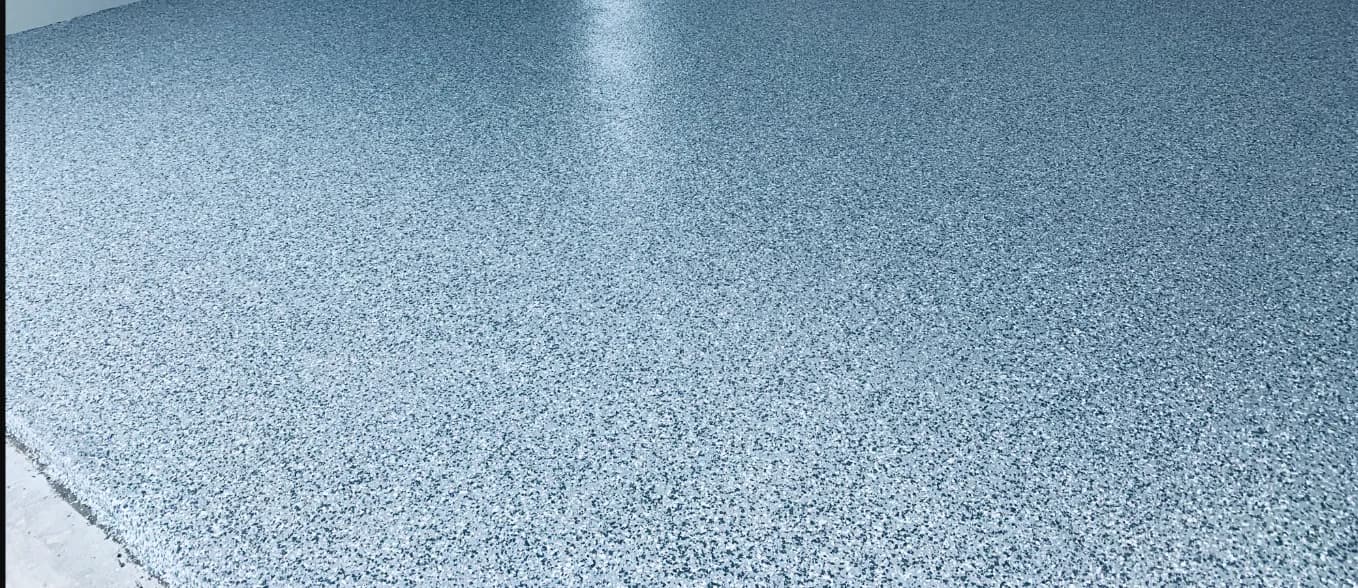
Manufacturers put fifteen to twenty five years on a polyaspartic flake system. That figure is real, and it assumes the floor was installed correctly onto a properly prepared slab. Most of the failed floors we are called to look at are nowhere near that age.
So the honest answer to how long a coating lasts is: as long as the bond holds. Everything else is secondary.
What actually ends a floor
The bond fails. This is the big one, and it is decided before the first coat goes down. A coating keyed into ground concrete lasts decades. A coating sitting on a closed, troweled or acid etched surface starts lifting at the edges in two or three years. That is not a product lifespan, it is a preparation failure with a delay built in.
Water gets underneath. Vapor driving up through a slab with no barrier under it will push a sealed coating off from below no matter how well it was bonded on top. This is a basement problem far more than a garage problem, and it is why a basement slab gets tested before it gets priced.
The slab moves. If the concrete settles, heaves or cracks structurally, the coating goes with it. No system bridges a slab that is moving underneath it.
What does not end a floor
Normal use, mostly. A flake system takes hot tires, dropped tools, road salt, oil and jack stands without complaint. The topcoat wears, slowly and evenly, in the areas that get walked and driven most.
That even wear is the useful part: a floor that is wearing rather than failing can be recoated. Once the topcoat is thin, the flake layer underneath is still intact and still bonded, and a fresh polyaspartic coat brings the whole floor back. That is a cheap job compared with starting again, because none of the preparation has to be redone.
The realistic number
For a residential garage in this valley, on a slab that was ground properly and has no moisture problem, expect the floor to look good for well over a decade and to be a candidate for a refresh topcoat somewhere in the second half of its life.
Ours carry a fifteen year written warranty. We chose that number because we can stand behind it rather than because it sounds impressive.
What shortens it
- Grit left on the floor. Sand and road salt crystals are abrasive, and dragging a car tire over them is effectively sanding your own topcoat.
- Standing chemicals. Most household and automotive spills are fine wiped up. Left in a puddle for a fortnight, some are not.
- Dragging metal. Jack stands, engine hoists and toolboxes with steel feet will scratch any resin floor. Put something under them.
None of these are dramatic, and all of them are avoidable with a broom.
Related
- Why coatings peel, which is the failure this post is really about
- How to clean it so the wear stays even
- What we install, layer by layer
Reference
Coating manufacturers write their warranty terms against a prepared substrate, and the standard those preparation requirements refer to is Guideline 310.2R from the International Concrete Repair Institute.