
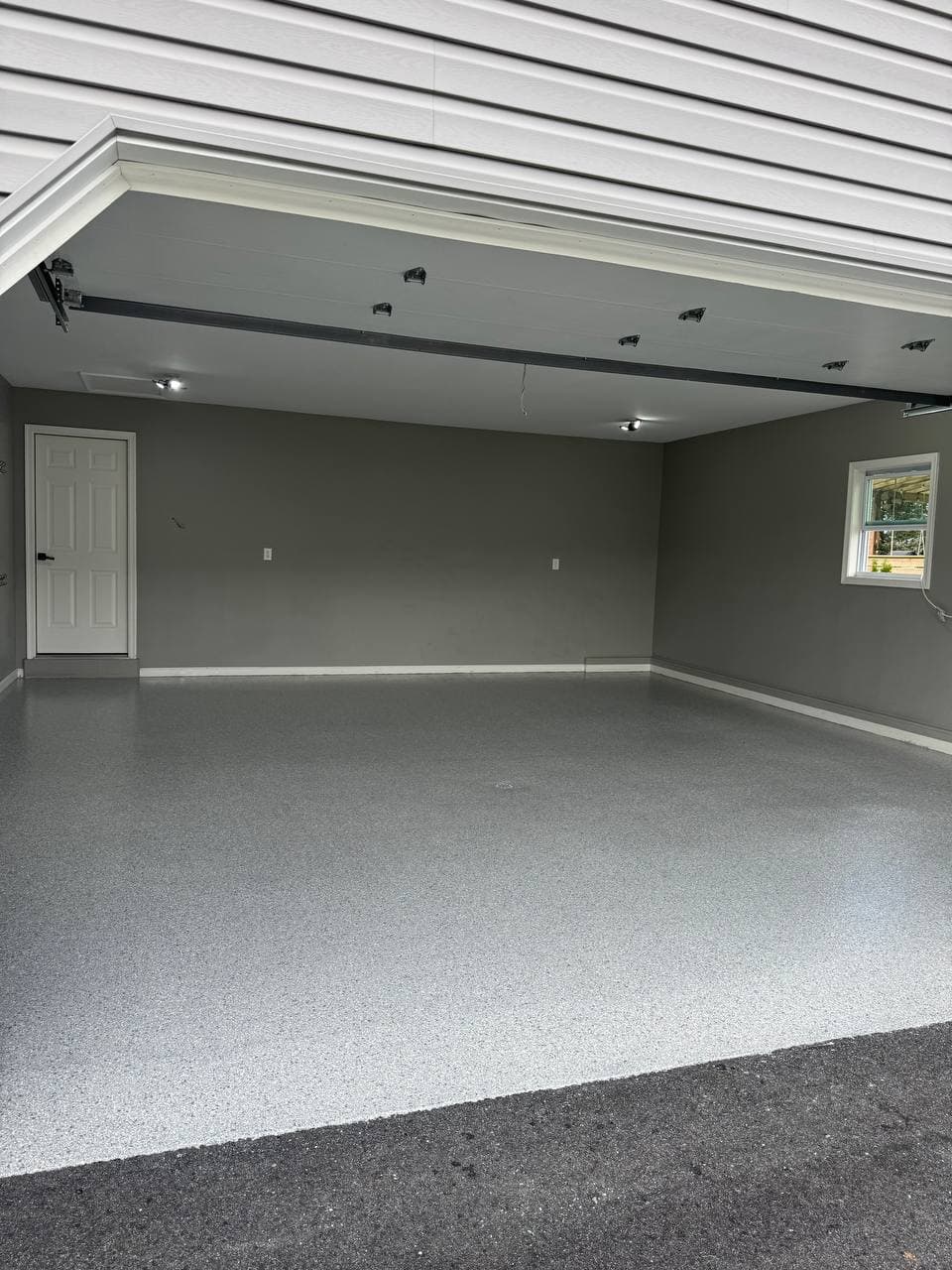
New construction throws up a question people expect to be simple: the slab is brand new and perfectly clean, so surely it is the easiest floor to coat.
It is usually the harder one, for two separate reasons.
Reason one: it is still wet inside
Concrete does not dry, it cures. Hydration continues for a long time after the surface is walkable, and a great deal of water is still leaving the slab for weeks afterwards.
The rule of thumb everybody quotes is 28 days, and it is worth knowing what that number actually refers to. Twenty eight days is the standard age at which concrete is tested for compressive strength. It is a strength benchmark, not a moisture benchmark, and the two are not the same thing.
For coating purposes what matters is how much moisture is still coming out. On a slab cast on grade in a New England winter, 28 days can be nowhere near enough. In a warm, ventilated space it may be plenty.
The way you find out is not the calendar. It is a moisture test: calcium chloride to ASTM F1869, or an in situ relative humidity probe to ASTM F2170.
Reason two: the surface is closed
A new slab has usually been power troweled to a hard, dense, attractive finish. That finish is the problem.
Troweling brings fines to the surface and compacts them into a closed layer with very low porosity. It looks like the best possible surface to bond to and it is close to the worst, because there is nothing for a coating to key into.
New slabs also often carry a curing compound, a membrane sprayed on to slow water loss during hydration. It has to come off completely before anything can bond, and some of them are stubborn.
So the newest, cleanest, best looking floor in the building frequently needs the most grinding. That surprises builders more than homeowners.
What we do on new construction
- Ask when the slab was poured and under what conditions
- Test moisture rather than counting days
- Grind, always, and expect to remove a curing compound
- If the reading is high, either wait or specify a moisture tolerant primer, and put that on the quote as a line item
If you are building right now
Two things you can do that make the floor cheaper later.
Specify a vapor barrier under the slab. It costs very little at pour and it removes the single biggest cause of coating failure for the life of the building. This is worth pushing your builder on.
Tell the concrete contractor the floor is going to be coated. A slab that will be coated does not need a hard steel trowel finish, and a lighter finish saves grinding time later. It also means they are less likely to use a curing compound that fights you afterwards.
Both are free or nearly free at the right moment and expensive to fix afterwards.
Related
- Moisture testing explained, both methods
- Why coatings peel, including the closed surface problem
- What we install and how the day runs
Reference
The two moisture methods referenced here are ASTM F1869 and ASTM F2170. For hydration and curing behaviour generally, see the Portland Cement Association.