
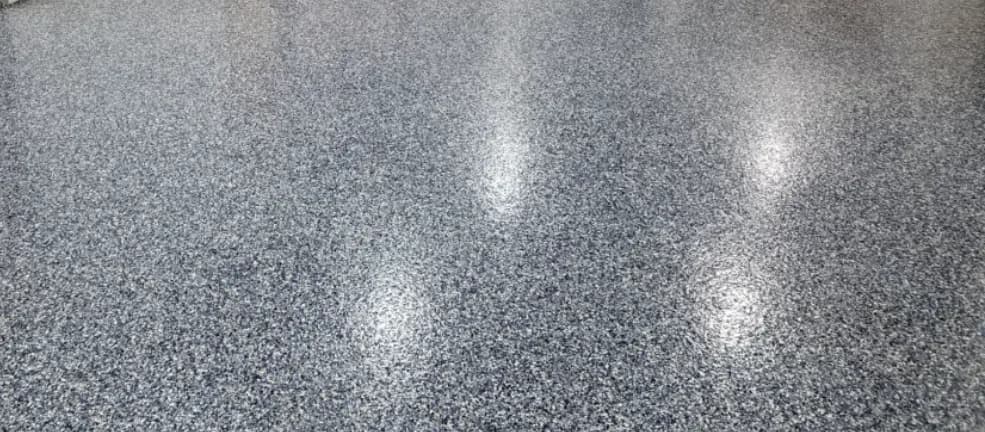
An attached garage borrows a little heat from the house whether you want it to or not. A detached one borrows nothing. That single difference changes what the slab does across a year, and it is why detached garages are usually the worst concrete on a property.
What the temperature swing does
An unheated detached garage in this valley can sit near zero in January and well above eighty in July. The slab expands and contracts through that whole range, and it does it faster than an attached garage because there is no buffer on any side.
A brittle coating bonded to a slab moving that much has two options: crack, or let go at the edges. This is exactly the failure mode epoxy has, and it is the clearest practical argument for a polyurea basecoat that stays flexible after it cures.
The slab is often thinner
Detached garages, especially older ones, were frequently poured light. Four inches is typical for a house garage; some detached slabs and older barn floors are less, sometimes over a base that was never properly compacted.
That matters in two ways. A thinner slab flexes more under a car, which is more movement for the coating to absorb. And it is more likely to have cracked already, which means more repair time before anything goes down.
No vapor barrier, and it shows
Attached garages usually sit at or above grade with the house's own drainage looking after them. A detached slab is more often poured directly onto grade with nothing underneath.
In a garage that is less catastrophic than in a basement, because the space is ventilated and the door opens. But on a slab that stays damp under a car all winter it is worth a moisture check before we price it rather than assuming.
What we do differently
- More repair time in the quote. We expect cracks and we expect to chase and fill them, and we say so at the estimate rather than discovering it on the day.
- Attention to the perimeter. Detached slabs often have a rough or unfinished edge where the pour met the form. That edge gets ground properly, because it is where lifting starts.
- The threshold. A detached garage door usually meets the driveway with no step and no seal. Water runs in. The coating has to terminate cleanly at that line rather than feather out into nothing.
- Power. Worth mentioning: some detached garages have a single circuit or none. Tell us at the quote and we will bring what we need.
Barns and outbuildings
Same rules, more of them. Agricultural and semi agricultural slabs see heavier point loads, more grit, and frequently were never finished to a standard that anticipated a coating.
They are still usually coatable. The repair line on the quote is just bigger, and we would rather show you that number than surprise you with it.
Related
- What we do on garage floors
- What can still be coated when the slab is already damaged
- Why the basecoat has to stay flexible
Reference
Slab assessment before coating, including soundness and profile, follows the guidance published by the International Concrete Repair Institute.