
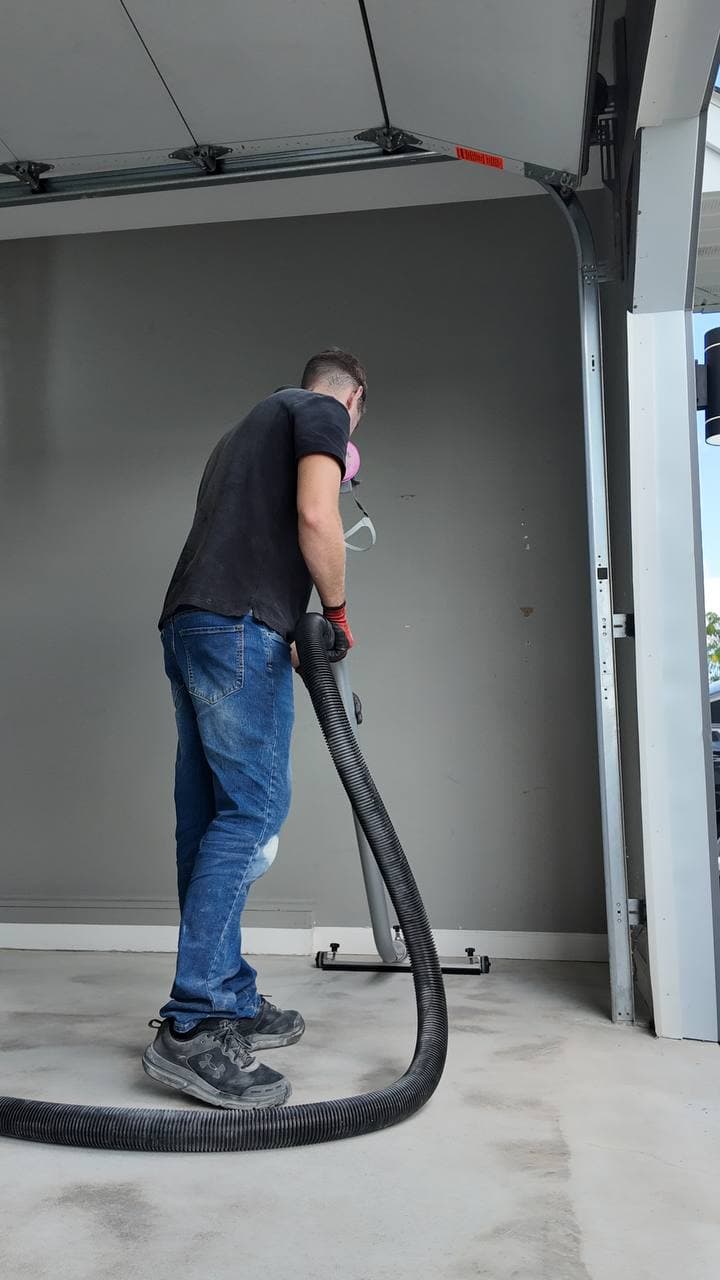
Most garage slabs were poured with a fall toward the door, usually somewhere around an eighth of an inch per foot. It is deliberate. It is how meltwater off a car in February leaves the building instead of sitting under it.
A coating has to respect that fall. Coatings that do not are the reason some floors pond after they are finished.
Levelling and flattening are different things
People often ask whether we can level the floor while we are at it. Almost always the honest answer is no, and usually you do not want it.
Flattening removes high spots so the surface is even. Grinding does some of this naturally.
Levelling means making the floor horizontal, which on a garage slab means removing the drainage fall the builder put there on purpose. Do that and every drip stays where it lands.
Where a floor genuinely ponds because the fall is wrong or a section has settled, a build up in the low area can help. That is a repair line on the quote and it has limits, because a coating is millimetres thick and settlement is measured in fractions of an inch.
Floor drains
Plenty of garages in this area have a drain, especially newer builds and anything with a workshop history.
Two things go wrong regularly.
The coating stops short of the drain. There is a ring of bare or old coated concrete around the drain body where everything collects. It looks unfinished and it is the first place to fail.
The drain body sits proud or low. If it was set wrong when the slab was poured, the coating cannot fix that. It can be feathered to reduce it.
Done properly, the coating is carried into the drain and terminated against the body, so there is no gap and nothing to get underneath.
The threshold
Where the slab meets the driveway is the hardest working two inches of a garage floor. It gets the most water, the most salt, the most sun and the most tire contact.
We terminate the coating cleanly at that line rather than feathering it out to nothing. A feathered edge is thin, and thin is where lifting starts. On a slab with a rough or damaged front edge, that edge gets repaired before it gets coated.
Trench drains and wash bays
Less common residentially, normal in shops. A trench needs the coating carried down into it and coved at the corners, which is more work than it sounds and it is where a cheap quote saves money.
Cove base in a garage
Rare in a house, but worth knowing about. Carrying the coating a few inches up the wall in a radius means the floor can be hosed and nothing collects in the corner. If your garage is really a workshop, it is worth asking about.
Related
- What we do on garage floors
- Detached garages, where the threshold matters most
- How install day runs
Reference
Substrate condition, including flatness and drainage, is assessed before coating under the preparation guidance from the International Concrete Repair Institute.