
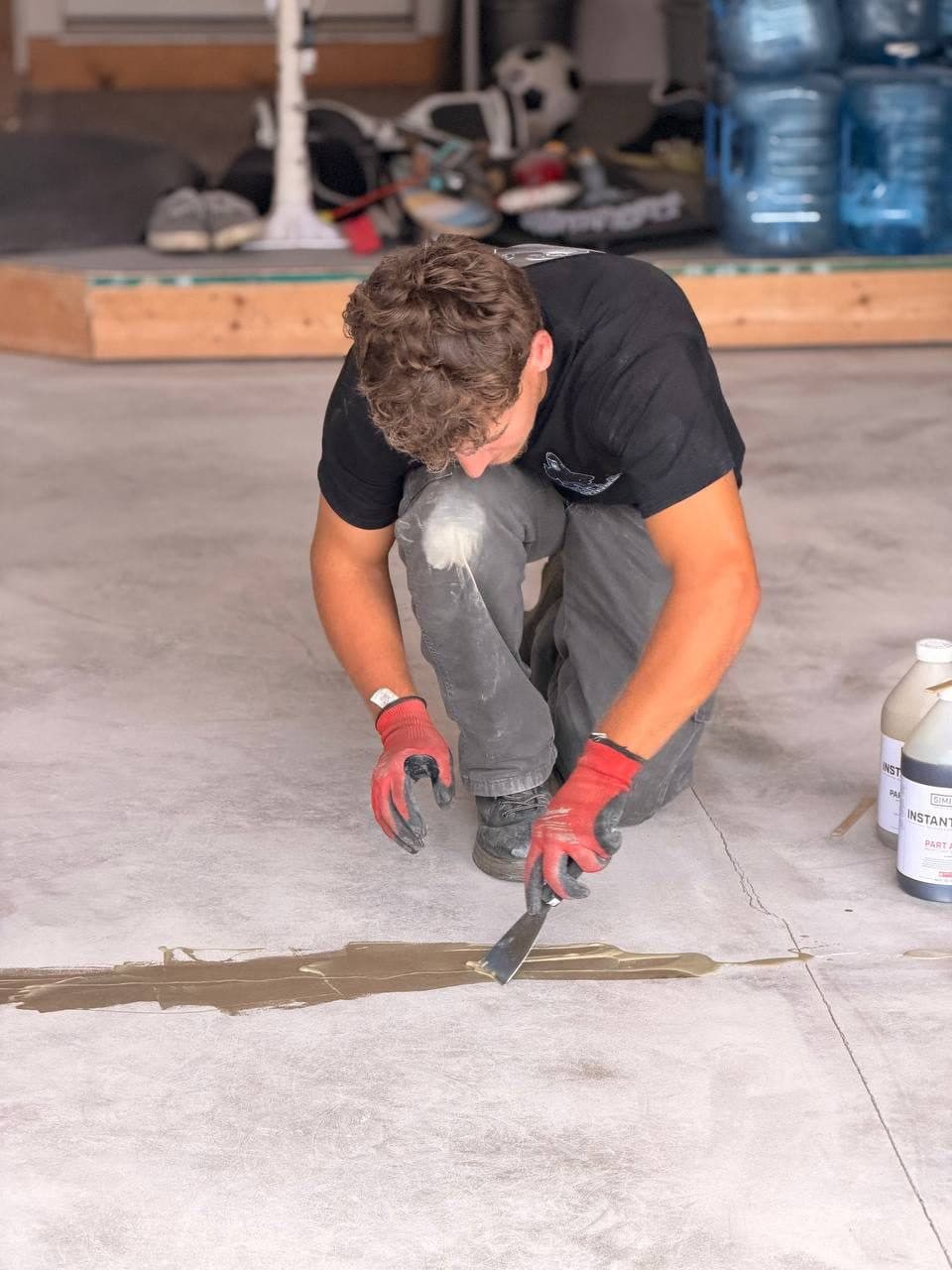
Every contractor's website has a stock photo of a garage floor. Fewer show the four hours before that floor exists: the truck backed up the driveway, the dust extractor running, somebody on their knees with a trowel. These are photographs from one of our own jobs, taken by the crew in the first week of September, not a diagram of how the process is supposed to work.
The trailer shows up first
Everything for the day comes off one trailer: the grinder, the dust extractor, the basecoat and flake, the topcoat, the squeegees and rollers. Nothing gets ordered mid job or picked up from a supplier because we ran short, which is also why we can tell you a fixed price before we start rather than a number that grows during the day.
Grinding and dust extraction, together
The grinder and the dust extractor run at the same time, not one after the other. Diamond segments open the slab to a proper concrete surface profile while the extractor pulls the dust out through a hose as it is produced, rather than letting it settle over everything in the garage. This is the step that decides whether the coating actually bonds to the concrete rather than sitting on top of it, and it is the least photogenic and most important hour of the day.
The basecoat goes down by hand
A polyurea basecoat is trowelled and rolled across the open concrete while it is still freshly ground. This is not a step that gets rushed: the basecoat is what the flake keys into, and an uneven basecoat shows through every layer applied on top of it afterward.
Flake, then two topcoats
Once the basecoat is down, vinyl flake gets broadcast to full refusal, meaning the floor is covered until it will not take any more. Two polyaspartic topcoats follow, each one applied with a squeegee first and a roller behind it to level it out. Polyaspartic cures fast enough that both topcoats go down the same day, which is the reason a five layer floor is finished in one visit rather than spread across a week of return trips.
What the crew is actually watching for
Not the clock. The concrete. Basecoat working time, flake density, and how the topcoat is laying down all get judged by eye and by feel rather than by a fixed schedule, because a slab that is slightly more porous in one corner or a garage that is a few degrees warmer than the last one changes how each layer behaves. That is also why two people from the same crew are usually working the floor together rather than one person moving through it alone: a second set of eyes catches an uneven pass before it sets.
Related
- What a day looks like, the same steps laid out start to finish
- How to prepare your garage for install day
- Grinding vs acid etching concrete, why that first hour matters more than any other
Reference
The concrete surface profile standard referenced in the grinding step comes from the International Concrete Repair Institute, Guideline 310.2R.