
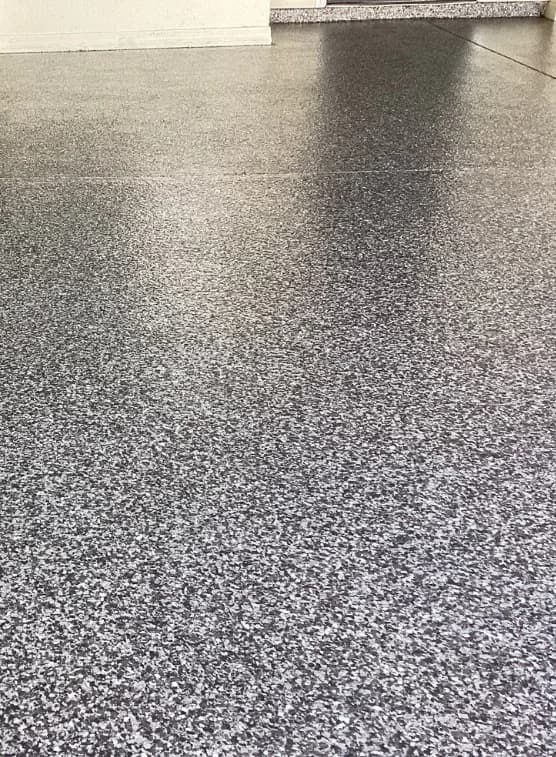
Three products get sold for the same job, and they are not variations on a theme. One changes the concrete. Two cover it up. That difference decides almost everything else.
Roll out mats
A vinyl or PVC sheet laid over the slab, usually in eight or ten foot widths.
Good at: being cheap, being immediate, being removable. If you rent, or you want the garage to look tidy by Saturday, a mat does that for a few hundred dollars and no preparation at all.
Bad at: everything underneath it. Water that gets under a mat stays under it, and in a garage that means every snow melt puddle sits against bare concrete in the dark. Salt goes with it. The slab keeps deteriorating, out of sight.
They also move. Tires push them, edges curl, and seams collect grit.
Interlocking tiles
Rigid PVC or polypropylene squares that click together into a floating floor.
Good at: looking sharp, going down fast, and hiding a slab that is genuinely ugly. They tolerate a slab that is not flat far better than a coating does, because they float rather than bond. They are also the only one of the three you can lift and replace in sections.
Bad at: seams. Every joint is a place for water, salt and grit to get through, and there are a great many joints. What gets through does not dry, because there is now a plastic lid over it. Tiles also sit the floor level up by half an inch, which matters at a door threshold.
Under load they can shift or pop apart, and a dropped jack stand will crack one.
A coating
A polyurea and polyaspartic build bonded into the ground slab.
Good at: being the floor rather than being on the floor. No seams, nothing to get underneath, nothing to lift. The slab is sealed against the salt and water that were degrading it, so the concrete stops getting worse. It takes hot tires, jack stands and dropped tools, and it cleans with a mop.
Bad at: being reversible, and being cheap. It is a permanent change to the concrete, it costs several times what tiles cost, and it needs a slab that is structurally sound. If your concrete has heaved or settled, a coating will look better and still be uneven.
The New England argument
In a climate without freeze and thaw, this is largely a preference question.
Here it is not. The mechanism that destroys a garage slab in this valley is water and brine getting into the concrete and freezing. Mats and tiles do not stop that happening; in some respects they make it worse, because the water that gets underneath cannot evaporate.
A bonded coating is the only one of the three that addresses the actual cause. That is not a marketing point, it is the physical difference between covering something and sealing it.
Rough cost picture
Mats are the cheapest by a wide margin. Tiles land in the middle and vary enormously by quality. A coating on a two car garage runs $7 to $10 a square foot installed, which you can work out for your own floor on the pricing page.
Related
- What road salt does to an uncovered slab
- What a coating costs
- What can still be coated if your concrete is already damaged
Reference
Freeze thaw and deicer scaling, the process a bonded coating is intended to stop, is described by the Pennsylvania Aggregates and Concrete Association in its technical sheet on concrete scaling.