
Two products get proposed for the same tired patio and they are not competing for the same job. One adds a pattern. One adds a wearing surface. Knowing which problem you actually have decides the answer.
What a stamped overlay is
A cementitious overlay, usually a quarter inch or so thick, troweled over the existing slab and stamped with mats while wet to imitate stone, slate or brick. It is then coloured and sealed.
Good at: appearance, and only appearance. If your complaint is that the patio is a plain grey rectangle, an overlay changes that dramatically.
Less good at: everything structural. It is a cement product, so it behaves like concrete: it absorbs water, it is vulnerable to the same freeze and thaw cycle that damaged the slab underneath, and it needs resealing every few years to keep looking right.
The stamped texture also traps dirt. Deep pattern joints in this climate collect grit, moss and leaf tannin, and cleaning them is a pressure washer job rather than a broom job.
What a coating is
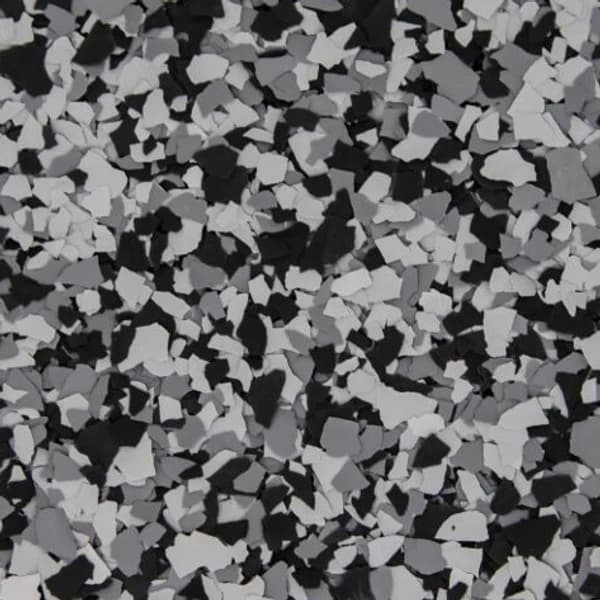
A bonded resin system, in our case a polyurea basecoat, a flake broadcast and two UV stable polyaspartic topcoats, ground into the slab.
Good at: sealing the concrete so water stops getting in, which addresses the actual cause of the damage. Non porous, so no resealing schedule. UV stable, so no yellowing. Texture is added deliberately as an anti slip additive rather than as a pattern that also collects dirt.
Less good at: imitating stone. A flake floor looks like a flake floor. It is handsome and it is not pretending to be slate.
Which one your patio needs
The slab is sound and you want it to look different. Overlay. That is the job it was invented for.
The slab is scaling, pitting or dusting. Coating. An overlay laid over deteriorating concrete inherits the deterioration; you have added a quarter inch of new cement to a surface that is coming apart underneath it.
You want both. Possible in principle and expensive in practice, and we would usually talk you toward one.
The freeze thaw argument
This is where the two genuinely separate in a Massachusetts context.
An overlay is porous cement. It takes water in, and water in cement in January is the mechanism that damaged the original slab. Overlays in this climate typically need resealing on a cycle, and a neglected overlay scales the same way concrete does.
A coating is not porous. Water does not get in, so the freeze thaw cycle has nothing to act on. That is the whole reason to seal an exterior slab here rather than resurface it decoratively.
Cost and lifespan, roughly
Overlays and coatings land in broadly similar territory per square foot, which surprises people who assume the resin product is the expensive one.
The difference shows up over time. An overlay carries a resealing schedule. A coating does not.
Related
Reference
The freeze thaw and scaling mechanism that affects both cement overlays and untreated slabs is described in the Pennsylvania Aggregates and Concrete Association technical sheet on scaling.